This post is to bookmark down this page which is a huge gem.
It capture the essence of that blog and financial freedom. Aside from the more US-specific investment strategy, all the ideas written there are fantastic and applicable to Singapore.
The first 7 chapters are must read, especially on the market always going up and how fund managers rip us off.
"The market always, and I mean always, goes up. Not each year. Not each month. Not each week and certainly not each day. But relentlessly up."
"The fact is only 20% of fund managers will beat the Index over time. 80% will fail. 100% of them will charge you high fees to try. There is no predicting which will be in that rarefied 20%.
Every fund prospectus carries this phrase: “Past results are not a guarantee of future performance.” It is the most ignored sentence in the whole document. It is also the most accurate."
And how we have become so accustomed to debt - the greatest obstacle to wealth building.
"If you intend to achieve financial freedom you are going to have to think differently. It starts by recognizing that debt should not be considered normal. It should be recognized as the vicious, pernicious destroyer of wealth-building potential it truly is. It has no place in your financial life."
Saturday, April 29, 2017

Sunday, April 02, 2017
Letter To Shareholders (6) - Performance Review 2017Q1
Performance Highlights
The market went on a crazy bull run since the start of the year with STI exploding 300 points. Rising tides lift all boats and our portfolio leapfrogged 9.5% into positive territory after 2 years.
Looking back, we can only regret not pumping more capital into the market during the downturn, even though we are intrigued with the crazy run-up in US.
On a positive note, we paid out dividends of over $1000 (base on pay-date), highest ever for Q1 since inception.

Operating Highlights
As forecasted, income for the quarter were almost 40% lower than the same period last year. This was mainly due to:
- Absence of bonus in January and March.
- No Chinese New Year winnings (compared to Feb last year)
Earnings is expected to catch up in the following 3 quarters.
 Expenses were about 16% higher compared to last year, but inline with 2 year average. This was mainly due to:
- Gambling losses during the CNY period (charged in January).
- Wedding events in February.
- Mayday Concert and board game purchase in March.

Acquisitions & Divestments
The market run-up means less opportunities, although we managed to nibble a tiny bit of CapitalMall Trust due to partial fulfillment. Lesson learnt: Do not be afraid to just buy at market value if we strongly believe in the purchase. In this case, we missed a substantial run up due to wanting to save $50.
Super Group was finally privatized and we let go of our holdings at a overall loss of 25%. A lesson for blindly buying at high prices and not having the conviction to average down after the shares plummet 50%. Thankfully, this is the smallest holding in our portfolio and the damage is minimal.
Bank Accounts
The unexpected bad news was yet another downgrade of OCBC360 account. Fortunately, we have maxed out our Maxigain counter (our plan 1 year ago finally bearing fruit) at 1.2% bonus interest. With rising US interest rates, SIBOR rate is also expected to trend up.
Considering these changes, our cash account rankings are as follow:
1. Citibank Maxigain: 0.55+% for the first month, ~1.75+% subsequently. Withdrawal conditions.
2. OCBC 360: 1.55%, 1.85% on certain months.
3. CIMB Fastsaver: 1% unconditional.
We are saddened by the change and have explored other options, but have not find any with a definitive advantage over OCBC360. This is because we are unable to the meet the $500 spending in most months which most other banks require.
For now, our immediate action is to reduce reliance on CIMB Fastsaver and direct more into our stock holdings to meet this year dividends goal. Any long term reserves will go straight into Maxigain, and OCBC360 will store our bullets.
We applied for the SCB Unlimited Cashback card with 1.5% rebate, which we believe present the best value for us at the moment. We will be closing the Bank of China account.
Financial Strength
DBS Vickers is currently having a major promotion with reduced commissions (0.12% with min $10, down from 0.18%) until June.
In other news, Budget 2017 announced tax rebate of 20% up to $500 this year, which would result in slightly lower tax expenses.
Our financial strength is at an all time high with more than 5 years of emergency funds and 10 years of warchest.
Outlook
Our immediate priority is to deploy cash as soon as reasonable opportunities come along before the strong dividend months of May and August arrive. Hopefully we can see some market corrections soon.
Barring unexpected circumstances, we expect higher dividends for the next 3 quarters.
The market went on a crazy bull run since the start of the year with STI exploding 300 points. Rising tides lift all boats and our portfolio leapfrogged 9.5% into positive territory after 2 years.
Looking back, we can only regret not pumping more capital into the market during the downturn, even though we are intrigued with the crazy run-up in US.
On a positive note, we paid out dividends of over $1000 (base on pay-date), highest ever for Q1 since inception.

Operating Highlights
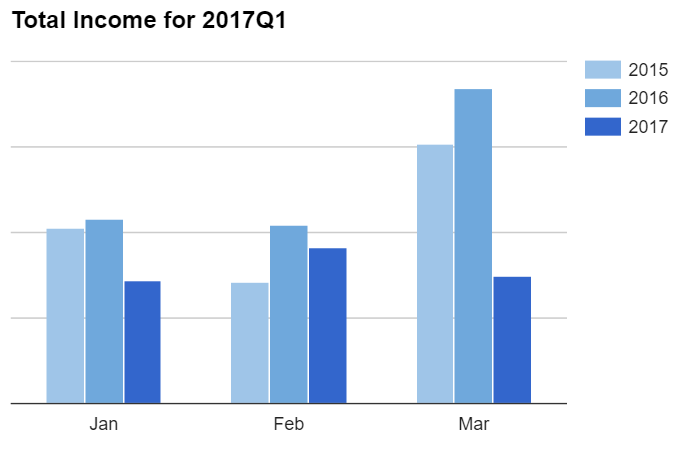
As forecasted, income for the quarter were almost 40% lower than the same period last year. This was mainly due to:
- Absence of bonus in January and March.
- No Chinese New Year winnings (compared to Feb last year)
Earnings is expected to catch up in the following 3 quarters.
- Gambling losses during the CNY period (charged in January).
- Wedding events in February.
- Mayday Concert and board game purchase in March.

The market run-up means less opportunities, although we managed to nibble a tiny bit of CapitalMall Trust due to partial fulfillment. Lesson learnt: Do not be afraid to just buy at market value if we strongly believe in the purchase. In this case, we missed a substantial run up due to wanting to save $50.
Super Group was finally privatized and we let go of our holdings at a overall loss of 25%. A lesson for blindly buying at high prices and not having the conviction to average down after the shares plummet 50%. Thankfully, this is the smallest holding in our portfolio and the damage is minimal.
Bank Accounts
The unexpected bad news was yet another downgrade of OCBC360 account. Fortunately, we have maxed out our Maxigain counter (our plan 1 year ago finally bearing fruit) at 1.2% bonus interest. With rising US interest rates, SIBOR rate is also expected to trend up.
Considering these changes, our cash account rankings are as follow:
1. Citibank Maxigain: 0.55+% for the first month, ~1.75+% subsequently. Withdrawal conditions.
2. OCBC 360: 1.55%, 1.85% on certain months.
3. CIMB Fastsaver: 1% unconditional.
We are saddened by the change and have explored other options, but have not find any with a definitive advantage over OCBC360. This is because we are unable to the meet the $500 spending in most months which most other banks require.
For now, our immediate action is to reduce reliance on CIMB Fastsaver and direct more into our stock holdings to meet this year dividends goal. Any long term reserves will go straight into Maxigain, and OCBC360 will store our bullets.
We applied for the SCB Unlimited Cashback card with 1.5% rebate, which we believe present the best value for us at the moment. We will be closing the Bank of China account.
Financial Strength
DBS Vickers is currently having a major promotion with reduced commissions (0.12% with min $10, down from 0.18%) until June.
In other news, Budget 2017 announced tax rebate of 20% up to $500 this year, which would result in slightly lower tax expenses.
Our financial strength is at an all time high with more than 5 years of emergency funds and 10 years of warchest.
Outlook
Our immediate priority is to deploy cash as soon as reasonable opportunities come along before the strong dividend months of May and August arrive. Hopefully we can see some market corrections soon.
Barring unexpected circumstances, we expect higher dividends for the next 3 quarters.
Friday, March 17, 2017
Why Do We Get Stuck In The Rat Race?
This week, someone I know was administered into the hospital and I went to visit him.
There, I see many frail and old people.
Tubes and needles being inserted into them... It's a really saddening sight.
I think it's something people of my age don't really get to see often.
It's something we don't think about because we still have our youth and health.
...
I imagined the day when I would be lying down on one of these bed, looking back at what I have achieved.
When we were young, we were processed through the system to study. When we reached our 20s, we put off plans to pursue our interests to get into higher paying jobs. In our 30s or 40s, we delay plans to travel the world in order to build our families, to pay off our housing loans.
And then we continue to put off plans to pay for our kids university, to buy a bigger house, a bigger car, etc...
Before you knew it, we would be in our 60s.
By then, we would have lost most of our health and energy.
Do we really want a life where we only live to pursue more and more zeroes in our bank account? Or is this just some plan to enrich other people? Other people who created this "system" who made us think this is a normal life?
For me, I know when I will have enough.
Enough that I can tell myself: I won't be a burden to society or anyone. I can feed myself and live in contentment. And I will know it's time to quit the race.
"How in the hell could a man enjoy being awakened at 6:30am by an alarm clock, leap out of bed, dress, force-feed, shit, piss, brush teeth and hair, and fight traffic to get to a place where essentially you made lots of money for somebody else and were asked to be grateful for the opportunity to do so?" - Charles Bukowski
There, I see many frail and old people.
Tubes and needles being inserted into them... It's a really saddening sight.
I think it's something people of my age don't really get to see often.
It's something we don't think about because we still have our youth and health.
...
I imagined the day when I would be lying down on one of these bed, looking back at what I have achieved.
When we were young, we were processed through the system to study. When we reached our 20s, we put off plans to pursue our interests to get into higher paying jobs. In our 30s or 40s, we delay plans to travel the world in order to build our families, to pay off our housing loans.
And then we continue to put off plans to pay for our kids university, to buy a bigger house, a bigger car, etc...
Before you knew it, we would be in our 60s.
By then, we would have lost most of our health and energy.
Do we really want a life where we only live to pursue more and more zeroes in our bank account? Or is this just some plan to enrich other people? Other people who created this "system" who made us think this is a normal life?
For me, I know when I will have enough.
Enough that I can tell myself: I won't be a burden to society or anyone. I can feed myself and live in contentment. And I will know it's time to quit the race.
"How in the hell could a man enjoy being awakened at 6:30am by an alarm clock, leap out of bed, dress, force-feed, shit, piss, brush teeth and hair, and fight traffic to get to a place where essentially you made lots of money for somebody else and were asked to be grateful for the opportunity to do so?" - Charles Bukowski
Thursday, March 16, 2017
What Can You Learn From Board Games?
Wow!
If I recall correctly, this would be my first full year of attending the Board Games Meetup.
To date, I've played around 100 games of all kinds: Cooperative, deduction, classic-euro, negotiation, diplomacy, economic, dexterity, resource management, etc...
And for each game, you can learn all kind of "soft-skills", such as:
1. Expand your vocabulary and ability to link unrelated stuffs in Codenames.
2. Train your ability to keep a straight face and "sow discord" in Secret Hitler.
3. Test your imagination and judgement skills in Dixit.
4. Your negotiation and charisma to bring people to your side in I'm the Boss.
5. Your deduction, story-telling, teamwork and puzzle solving skills in Time Stories.
The list goes on.
I think "outsiders" are still stuck in the old days where they think Board Games = Monopoly, Scrabble and Uno.
Nowadays, there are much more variety of games that engages you in all aspects.
-----------------------------------------------------------------------------------------------------------------------
Recently, I've had the chance to play this game call "Panic on Wallstreet", a negotiation economic game based on luck and probability.
Playing this game, I can really feel the different styles that different kind of players adapt.
While most managers and investors play "by the rules" and negotiate in the pit, there are a couple who "strike up their own private deals". Instead of touting in the mass market, they build up their own network by personally approaching investors.
This builds up "rapport" and "regular customers" which they can take advantage of, where they have less fear of failing to sell their stocks. On the other hand, time pressure can often force managers to let go of their properties at ridiculously low-price.
We have master mathematicians who try to bid for deals where they will "never lose" (at most break-even), and master negotiators who try to squeeze every inch of juice out from the other party.
I just feel it's amazing that I can see such diverse attitudes and styles towards a simple game that simulate the real world.
If I recall correctly, this would be my first full year of attending the Board Games Meetup.
To date, I've played around 100 games of all kinds: Cooperative, deduction, classic-euro, negotiation, diplomacy, economic, dexterity, resource management, etc...
And for each game, you can learn all kind of "soft-skills", such as:
1. Expand your vocabulary and ability to link unrelated stuffs in Codenames.
2. Train your ability to keep a straight face and "sow discord" in Secret Hitler.
3. Test your imagination and judgement skills in Dixit.
4. Your negotiation and charisma to bring people to your side in I'm the Boss.
5. Your deduction, story-telling, teamwork and puzzle solving skills in Time Stories.
The list goes on.
I think "outsiders" are still stuck in the old days where they think Board Games = Monopoly, Scrabble and Uno.
Nowadays, there are much more variety of games that engages you in all aspects.
-----------------------------------------------------------------------------------------------------------------------
Recently, I've had the chance to play this game call "Panic on Wallstreet", a negotiation economic game based on luck and probability.
Playing this game, I can really feel the different styles that different kind of players adapt.
While most managers and investors play "by the rules" and negotiate in the pit, there are a couple who "strike up their own private deals". Instead of touting in the mass market, they build up their own network by personally approaching investors.
This builds up "rapport" and "regular customers" which they can take advantage of, where they have less fear of failing to sell their stocks. On the other hand, time pressure can often force managers to let go of their properties at ridiculously low-price.
We have master mathematicians who try to bid for deals where they will "never lose" (at most break-even), and master negotiators who try to squeeze every inch of juice out from the other party.
I just feel it's amazing that I can see such diverse attitudes and styles towards a simple game that simulate the real world.
Sunday, March 05, 2017
Every Singaporean Life?
Come across this fascinating article about the supposed life of every Singaporean, and the author rebuttal against it.
My thoughts?
When you want 5 star hotel wedding, take 30 year loan for million dollar condo, buy big car, go annual vacation to Europe/US, change latest iphone every year, how to save for retirement?
Chinese have this saying: No so big head, don't wear so big hat. If you are a peasant (and earn a peasant income), don't try to live an elite life.
No doubt there are people truly living in poverty in Singapore (don't earn enough to even put 3 meals on table, much less save), but also got lot of cases is people die die want to buy something they can't afford (throw all their savings/take on big debts for car and house) and then claim they nothing left for retirement.
I don't deny the cost of living in Singapore is extremely high, but I think that gives us even more reason to be prudent with our earnings.
"Rich people stay rich by living like they're broke. Poor people stay poor by living like they're rich."
I can only shrug my shoulders when I see people who are lazy to even write a form to credit their salary to a higher interest account (a one time effort and gets you free money).
-----------------------------------------------------------------------------------------------------------------------
Instead of the article, I would like to propose an alternative.
The below assumes you have the privilege to pursue financial independence. Generally, this means:
- You and your dependents (family), are generally healthy and does not have long term and huge medical bills.
- Your family does not depend on you for survival, and you do not have to spend a huge portion of your income on them.
- You income is not too low (Subjective, but I would say below 2.5K)
In my opinion, most graduates from middle income family would have no problem meeting these criteria.
1. Study hard, get a good degree, earn a median income and try to have as high of a saving rate as possible, especially in your 20s (the first 5 year is crucial).
2. If applicable, clear all your debts ASAP, do not rack up credit card or any other debt, and do not waste money on useless shit. Do not take debt to go on vacation, buy liabilities and other non-income producing crap.
3. Save up emergency fund of 6 months, and put them in a high interest account. Then start saving for your warchest. Try to hit 1 year annual saving before 30s. This immediately gives you passive income of $1.2K per year (or ~$100 per month).
4. Start investing properly and correctly. Even if you are extremely conservative, you should get around 5% return over the long term.
5. Earn money -> invest -> collect dividends -> re-invest your dividends. Keep repeating this for the next 10 years.
6. If you decide to get married, have a simple wedding, simple honeymoon, buy an affordable house. Do not buy a car. If you have a child, be prepare to delay your retirement if you want to send your kid to expensive enrichment and tuition. If you really want to leave a legacy for your child, try starting a portfolio for him/her instead. He/she will have additional 20 years of compounding.
7. If you follow this diligently, by the time you're in your 40s, your investment (passive income) can easily cover more than half of your expenses (saving rate ~50%). If your saving rate is truly insane (>70%), you might even reach financial independence here. If you haven't, continue doing step 5 for the next 10 years and you would achieve the same. It's all up to your saving rate at this point.
8. As a guideline, aim to have minimum 1 year annual income of savings by 30s. 5 by 40s, 10 by 50s.
If you are willing to even put in a little effort to learn right investing, optimize your savings, and don't over indulge in luxuries, I am very sure most can achieve FIRE within 20 years. Many local bloggers have achieved it much much earlier on median income, in their 30s even. So 20 years is a really conservative estimate already.
Problem is, are people willing to put in the effort?
-----------------------------------------------------------------------------------------------------------------------
An article from the Four Pillar that I feel closely related to this article.
Essentially, this post is saying it's difficult to change human behavior and beliefs (just like my post about old generation view of insurance). We are like opium addicts of consumerism.
To them, it's a ridiculous idea. It's in the realm of "what they do not know they do not know" - like the 4th dimension.
My thoughts?
When you want 5 star hotel wedding, take 30 year loan for million dollar condo, buy big car, go annual vacation to Europe/US, change latest iphone every year, how to save for retirement?
Chinese have this saying: No so big head, don't wear so big hat. If you are a peasant (and earn a peasant income), don't try to live an elite life.
No doubt there are people truly living in poverty in Singapore (don't earn enough to even put 3 meals on table, much less save), but also got lot of cases is people die die want to buy something they can't afford (throw all their savings/take on big debts for car and house) and then claim they nothing left for retirement.
I don't deny the cost of living in Singapore is extremely high, but I think that gives us even more reason to be prudent with our earnings.
"Rich people stay rich by living like they're broke. Poor people stay poor by living like they're rich."
I can only shrug my shoulders when I see people who are lazy to even write a form to credit their salary to a higher interest account (a one time effort and gets you free money).
-----------------------------------------------------------------------------------------------------------------------
Instead of the article, I would like to propose an alternative.
The below assumes you have the privilege to pursue financial independence. Generally, this means:
- You and your dependents (family), are generally healthy and does not have long term and huge medical bills.
- Your family does not depend on you for survival, and you do not have to spend a huge portion of your income on them.
- You income is not too low (Subjective, but I would say below 2.5K)
In my opinion, most graduates from middle income family would have no problem meeting these criteria.
1. Study hard, get a good degree, earn a median income and try to have as high of a saving rate as possible, especially in your 20s (the first 5 year is crucial).
2. If applicable, clear all your debts ASAP, do not rack up credit card or any other debt, and do not waste money on useless shit. Do not take debt to go on vacation, buy liabilities and other non-income producing crap.
3. Save up emergency fund of 6 months, and put them in a high interest account. Then start saving for your warchest. Try to hit 1 year annual saving before 30s. This immediately gives you passive income of $1.2K per year (or ~$100 per month).
4. Start investing properly and correctly. Even if you are extremely conservative, you should get around 5% return over the long term.
5. Earn money -> invest -> collect dividends -> re-invest your dividends. Keep repeating this for the next 10 years.
6. If you decide to get married, have a simple wedding, simple honeymoon, buy an affordable house. Do not buy a car. If you have a child, be prepare to delay your retirement if you want to send your kid to expensive enrichment and tuition. If you really want to leave a legacy for your child, try starting a portfolio for him/her instead. He/she will have additional 20 years of compounding.
7. If you follow this diligently, by the time you're in your 40s, your investment (passive income) can easily cover more than half of your expenses (saving rate ~50%). If your saving rate is truly insane (>70%), you might even reach financial independence here. If you haven't, continue doing step 5 for the next 10 years and you would achieve the same. It's all up to your saving rate at this point.
8. As a guideline, aim to have minimum 1 year annual income of savings by 30s. 5 by 40s, 10 by 50s.
If you are willing to even put in a little effort to learn right investing, optimize your savings, and don't over indulge in luxuries, I am very sure most can achieve FIRE within 20 years. Many local bloggers have achieved it much much earlier on median income, in their 30s even. So 20 years is a really conservative estimate already.
Problem is, are people willing to put in the effort?
-----------------------------------------------------------------------------------------------------------------------
An article from the Four Pillar that I feel closely related to this article.
Essentially, this post is saying it's difficult to change human behavior and beliefs (just like my post about old generation view of insurance). We are like opium addicts of consumerism.
To them, it's a ridiculous idea. It's in the realm of "what they do not know they do not know" - like the 4th dimension.
Subscribe to:
Posts (Atom)