Showing posts with label Investment. Show all posts

Wednesday, May 14, 2025

Almost There...

Been a long time since I blogged anything (haha, life and laziness got in the way), and I'm so, so close to the end of the rat race.

It's time to take stock of how I intend to sustain myself once this is over.

Bucket 1 - Core Singapore
This consists of STI ETF, CFA ETF, REITs, local banks and other ahgong holdings like ST Engineering. The dividends generated can fully cover all my expenses.

Bucket 2 - Cash / SSB
More than $200K in this bucket, to act as "sleep well at night" fund aka margin of safety aka warchest during market downturn. It will fund any future large expenses (e.g. home renovation, top-up for home). In the meantime, the yield generated can supplement Bucket 1 for additional discretionary spending (e.g. holidays) or reinvestment.

Bucket 3 - CPF / OA
Around $250K now. One portion in CFA ETF, one portion I intend to deploy to Amundi World, and the rest will sit in OA. This will be utilized when I get a house - probably a 2-room BTO if nothing changes. In the more 'luxurious' case, I might get a 3-room resale which will be covered using Bucket 2.

Bucket 4 - CPF / SA
Aim to hit FRS (Almost there). That's it. The annual interest should be able to cover the rise in FRS.

Bucket 5 - US & Options
My 'trading' portfolio, where I hold a few US blue chips (e.g. Magnificient 7) and do wheel strategy to generate abit of kopi money. Based on historical performance in the past 3 years, I can generate around $5000 a year in option premium, which is reinvested into this bucket.

Bucket 6 - China / HK
My side bet on the rise of China with 3 main holdings - HS Tech, Tencent and BABA. This should be an indefinite hold until drawdown.

Bucket 7 - World ETF
Currently consists of SRS Funds (in Endowus, intend to transfer to Poems Amundi) and FWRA in IBKR. This is a small bucket (< $100K), but I hope to DCA for a little longer and then let it autoroll until drawdown.

--------------

I am at about 90% mark of the race. Just less than 2 years to go.

My only concern now is to build one last buffer against a future HDB purchase. I need to be confident of securing a house without drawing down my portfolio, and that'll be it.

For big luxury expense (e.g. if I want to Japan a few more times) in the future, I might drawdown from Bucket 5 or 6.

After FIRE-ing, my portfolio should still, minimally grow at a very slow pace (maybe $500 to $1000 per month). Will look to drawdown only when I hit my 50s.

Hang in there~!

Saturday, October 06, 2018

What Everybody Is Getting Wrong About FIRE

Another classic MMM article that will go down in history.

Strong valid points and rebuttal against all the FIRE-nayers, either because they are ignorant/misunderstood about what FIRE truly stands for, or they have a psychological problem of financial fear.

No matter how you look at it, FIRE can only be a good thing.

FIRE is not about early retirement.

FIRE is about giving you the freedom to be the happiest person you can possibly be.

When I see celebrities with 20M networth criticizing FIRE, they will probably say the same thing when they reach 200M networth.

How much is enough? Until the day you die?

Once again, nay-sayers are entertainment at best.

MMM is the real deal.

Friday, June 01, 2018

Quarterly Results Review - 2018Q1

M1
The results were just as I expected as mobile service revenue and profit increased slightly for the first time in a long time, signialling that earnings indeed bottomed in the last quarter. Of course, this is until TPG enters the battlefield.

At worst I forsee another 5-10% drop in earnings. EPS is 14.c in Y2017 - Assuming the worst case drop and EPS of 12.8c, an 80% payout ratio is 10.3c DPU which at $1.74 still gives a 5.9% yield. Assuming a steady DPU of 11c, we are hoping it would yield 6.3%. They have lot of initiatives such as waste management, SG bikes, corporate segment growth which we hope would eventually replace the declining mobile revenue. A secondary factor is confidence boost by several like-minded investors.'

As before, they are branching into other areas like malware detection solutions, nationwide IOT, smart sensors, "intelligent" waste management system, cloud offering of digital startups. Whether they will take off remains to be seen.

For now, my preference would be to take a small "swing" position to slowly recoup the losses, targetting to sell a portion above $1.9 (less than 6% yield) and buy should it come down to a reasonable price.


CapitaCommercial Trust
Headline figure was quite misleading as DPU drop 10+% due to the enlarged units base. Otherwise, DPU would have increased 7.6%.

Good results (DPU up 8.66%, 6% higher) but the stock price have shot through the sky. I really should have grit my teeth and sell when it was at more than $2. It is really unstainable considering the yield at that price is below 5%.

I believe it would be more fairly valued at $1.65 for a 5.5% yield, or at best $1.8 for 5% yield. The market are pricing in lot of growth from their AEI and Asia Square acquisition.


CapitaMall Trust
Slight increase in DPU to 2.78c for 1Q, and seems to be on track on meeting the 11c target. Yield remains at 5.4% yield at ~$2.0x. 

Announced divestment of Sembawang Shopping Centre which consist of only ~1% of CMT asset, but the surprise was selling it for ~$248m when the independent valuation is only half of that. Forumers who attended AGM mentioned CMT are conservative on their valuation, which seems to be good news if this sale hold any truth.


Starhill Global Trust
Starhill results slightly worse than I expected with DPU dropping by 7.6% (thought max would drop by 5%). Not sure how big a role the renovations played but a 7+% shopper traffic drop at Wisma seems bad. Hopefully DPU will stabalize in 2H with AEI completion in Australia.


Frasers Centrepoint Trust
In summary a good set of results led by Northpoint City.
 DPU of 3.10 cents, up 2.0% year-on-year (2Q17 DPU: 3.04 cents)
 Gross Revenue of $48.6 million, up 6.3% year-on-year
 Net Property Income of $34.8 million, up 6.9% year-on-year
 NAV per Unit of $2.03 as at 31 March 2018 (31 Dec 2017: $2.02)
 Gearing level at 29.2% as at 31 March 2018 (31 Dec 2017: 29.4%)


Frasers Property
Results swell this quarter to make up for the huge hit last quarter. Recurring income maintained at around 70%.

Frasers Centrepoint Limited renamed. Its share price has been on a downtrend since hitting $2.25.

Current NAV fell 4c to $2.42, and I expect dividends to be maintained at 8.6c a year (roughly 60% oapyout ratio). I am really treating this as an ETF and not reading much into the details. might add on more should it come to $1.7 (30% discount to NAV, 5% yield).


Far East Hospitality Trust
Finally we see glimpse of recovery after many consecutive quarters of DPU fall - it rises 1% to 0.94c. 

With contribution from Oasis Hotel Downtown (acquired on 2nd April) and recovery in the industry, better times and DPU should be ahead. Slight drag from Service Residences.

At 67c, this is one of the REIT which haven't run up significantly in price. I might consider adding if there are no better deals and it drops a bit more (to say around 63c).

Expect total DPU of 4c, which gives a yield of around 6%.


Sembcorp Industries
Almost all analysts are predicting $3.5 to as high as $4.4 target prices, but I still see no major turning point in the results. Yield at current price is a pathetic 2% and I am really reluctant to average down on this (I can get better yield from my banks).

Good points? The IPO in India is the major catalyst, and it is trading at relatively big discount to NAV of $3.6. If it falls to $2.70 I might do an average down.


Netlink Trust
Higher than IPO forcasted DPU of 3.24c declared. At $0.81, forecasted yield is around 5.7%

I have built a substantial position in this, and this will form a decent pillar in my dividend income.

Link to DBS Report


Singtel
Management finally committed to a dividend guidance of 17.5c, although I have never doubted Singtel ability to maintain it. This is definitely meant to assure investors in face of earning pressure (profits -18% in Q4). Payout ratio is at the highest at 81%.

At $3.40, Singtel currently trades at 10x EV/EBITDA (minus -2SD from historical mean), below its five year historical mean of 12x. It is also supported by a attractive yield of 5.1%. P/E is close to 10!

I would definitely add on more if I weren't already so heavily vested in it. I think I will fire one more bullet should it falls to $3.3, and reserve 1 final bullet for $3.


Accordia Golf Trust
Yield has gone down to 6% from the 7.5% I estimated when I first invested in this counter (roughly same price). Full year DPU is now just 3.85c, down from 6.04c last year. NAV stands at 90c.

It was hurt really badly by membership deposit in 1H and I doubt it will ever go back up to 78 high again. Utilization rates also plummet in Jan to Mar.

Management continue to iterate Japan's economy recovery, hopefully it prorpogates down to this counter. I will seriously consider selling it if the price rebounds or fundamentals continue to weaken (it has weaken for 3 quarters).


Watchlist / Potential 

M1 - Will sell this at $1.8+ to reduce exposure to Telco sector.

Singtel - Extremely attractive at committed 5.2% yield. Below $3.3.

Raffles Medical Group - Closer to $1. High P/E but long term growth story. China is make or break.

Comfort Delgro - $1.9 and below would be extremely tempting but boat is gone.

SGX - Closer to $7. India exchange saga impact unknown.

ThaiBev - A lot hinges on their Vision 2020. Debt is crazy after the acquisition spree. Results were bad as expected consumer recovery did not happen. Currently at 17.5 P/E, -1sd below 5 year average. 70c maybe?

Mapletree Comm Trust - Closer to $1.5, camping at 6% yield. NAV is $1.37.

ST Engineering - Would likely bite at 5% yield (closer to $3)

[Obsolete]

Capitaland - Look closer to $3.3 or below.

Mapletree Greater China Trust - $1.1 or when it retract to more than 7% yield.

Mapletree Logistic Trust - Despite >10% retracement still pretty expensive. If it comes closer to book value, say $1.1.


Tuesday, May 01, 2018

Is FIRE an unaccepted idea in Singapore?

I briefly shared the concept of FIRE with a couple of friends lately and while they did not openly denounce it, I can feel them almost sneering at that idea/me. Sadly, FIRE still have a big social stigma in Singapore. I have written about it before, but this time I am actually experiencing it for myself.

I feel you will either come off as trying to show off, having people think you earn a lot, or being totally unrealistic. FIRE is just too foreign to most Singaporeans - retirement is already impossible, and you're think about doing it much early?!

Just look at the amount of diss netizens rain on ASSI, 3Fs and other financial bloggers on the same path or have already achieved the dream. People that can do just do it, people that can't complain. Well, not that I need their approval.

Like this author experience, I think it's an "Asian Culture" problem. FIRE is seen as something "wihout ambition" and failure to contribute to society.

I see friends that are earning much much more than me (talking about near 5 digits) "struggling" to meet payments for all sorts of luxuries - new cars, mature estate HDBs with expensive renovations. Nothing wrong, just different priorities in life.

In fact, FIRE isn't a loftly or noble goal either. In fact, I think FIRE is largely a selfish goal, a goal to serve yourself.

Also, a modern society probably cannot sustain one where everyone else is working towards FIRE and minimialism. In a way, the FIREers are depending on the consumerism behaviour of the masses to survive.

Anyway, what's my ideal age to reach FIRE? I am of the same opinion as the Financial Sumari.

Sunday, April 01, 2018

Letter To Shareholders (10) - Performance Review 2018Q1

Economy Commentary
Finally we saw a glimpse of the bear in February. Volatility is returning and hopefully we will get some chances to deploy our funds. There were a couple of days when the DOW fell more than 1000 points, but it quickly rebounded. STI hasn't even retract 10% and this is definitely nowhere near major sale-terriority yet.

Macro wise - we have the threat of US-Sino trade war brewing, de-nuclearization of North Korea, more incoming interest hikes and who knows what else the crazy president is going to do.

Locally, there is a lot to learn from the Noble Group saga. When it fell from over $1 to 60c, people were saying "there is no point selling now, it is already so cheap. It can't possibly get any cheaper." Well, cheaper did it get. After a 10-to-1 reverse stock split and more rights issue, it has since lost a further 90+% of its value. The important lesson here is not just that cheap can get cheaper, but how crucial the management are to a company, particularly for a cut-throat business. When you got selfish, incompetent and some might even say corrupted management, it is just not worth investing in the company no matter how cheap it is.

Performance Review Highlights
Our portfolio underperformed for Q1, losing 2% compared to STI which is still up 1% YTD. It was dragged down mostly by the recent REITs correction and the slight decline in Singtel (our biggest holding). At the trough, our portfolio was down as much as by $8000 from peak.

Interesting note: Our equities holding is nearly doubled from the same period last year! This is proof of how much we are pumping into investments.

In this quarter - we added Starhill Global REIT and M1 Limited, decisions we would elaborate more on below. Thanks to Singtel special dividends - we paid out over $2000 in dividends in Q1 (the largest amount of any quarter by far)!


Operating Highlights - Income
I really did not expect main income to exceed the record 2016Q1 figure, but the higher base-income plus good bonus made it about 5% higher. Financial-wise, moving on to this new job is definitely the right move. We made higher income in all the past 4 quarter - and I think the difference will be even more pronounced this year. Looking forward to the year end tally.

On top of one-time income from CNY angbaos, we made some gambling winnings ($300+) this year (compare to a loss last year). Passive income is also signifcantly higher. In local news, government announces a minor angbao to be credited later in this year.

Operating Highlights - Expenses
A lot was spent on insomnia supplements and other sleep aid "devices" . Some of them are quite ridiculous, but I am desparate now. I will try it as long as it has a sound chance of working, and I will continue to hunt for an effective cure. I also "impulse add-on buys" a couple of board games at Amazon for over $150, which are mostly bad buys looking at it now. I don't forsee the games being played much going foward, and it really goes against my minimalism philosophy. Will definitely work on curbing these buys in the future.

2018 marked the first year of giving my mum CNY angbao, and I intend to keep this "tradition" going forward. This made up the bulk of the "one-time" expense category. Interestingly, when I compare recurring expenses for the past 4 years, it is almost equal (within ~5% of each other).


New Account - DBS Multipler
One of the major decision this quarter was moving from OCBC360 to the new DBS Multipler. I will not go into specific review of the Multipler (you can read it here), but for our case, it offers a more compelling rate, especially after the repeated downgrade made to OCBC.

For OCBC 360, I get 1.55% every month, and 1.85% occassionally.
For DBS Mutlipler, I get at least 1.9% every month, often 2.2-2.3%, and perhaps even 3.5%!

A rough estimation:
OCBC: $70000 x 1.6% = $1120
DBS + CIMB: $50000 x 2.0% + ($17000 x 1.0%) = $1000 + $170 = $1170
DBS + Maxigain: $50000 x 2.0% + ($17000 x 2.0%) = $1000 + $340 = $1340

This is assuming the $3K remain in OCBC to maintain the account fall below fee. I am leaving the account open to faciliate switching back if either banks revise their terms in the future, and also it is quite an hassle to close it due to all the GIRO payments.

Other side reasons:
- I no longer have to worry about "clocking $500" to meet the spending requirement of OCBC365.
- I have heard stories of OCBC beinga adamant about not waiving annual fee if you do not meet their spending requirements. This is in preparation for that day. (coming this year October)

Overall, I estimate this shift to earn an additional $200+ of free money per year.

Acquisitions
2 big positions taken up this term:

Starhill Global REIT: We have been eyeing to buy it this below 70c. When it seems like it would never come, we finally give in to pay a higher price. Still, it should be decent value. Near 6.5% yield (could drop further in next quarter, but confident that it would stablize once the AEI completes), 0.8P/B, a decent gearing of 35% and generally good management. There are plans by the government to "rejuvenate" Orchard Road - I'll reserve my judgement on how effective it would be.

M1: We would not deny it is partly a gamble to "recoup losses", but there are several positives we are betting on. Management guided lower capex next year ($120M in 2018 vs $150M in 2017), inclusive of spectrum rights. In our view, Q4 results showed sign of bottoming, with revenue increasing, EBITDA stabalizing and increasing customer base.

At worst we forsee another 5-10% drop in earnings. EPS is 14.c in Y2017 - Assuming the worst case drop and EPS of 12.8c, an 80% payout ratio is 10.3c DPU which at $1.74 still gives a 5.9% yield. Assuming a steady DPU of 11c, we are hoping it would yield 6.3%. They have lot of initiatives such as waste management, SG bikes, corporate segment growth which we hope would eventually replace the declining mobile revenue. A secondary factor is confidence boost by several like-minded investors.

Outlook
Aside a $1000+ upcoming vocation, recurring expenses should be similar to last year.

As of now, we still have working capital for 4 more acquisitions - and our watchlist includes Comfort Delgro, Raffles Medical Group, ThaiBev, Mapletree Commercial/Logistic/Greater China Trust, ST Engineering, Netlink Trust and Singtel.

Should a major correction comes a long, we intend to build a more substantial position in STI as long-term foundation - strategy is 1 bullet from 3200 points and another for every 200 points drop.

Tuesday, February 27, 2018

Quarterly Results Review - 2017Q4

It was a rough February as volatility returns to the US and I finally saw signs of the long-awaited bear. My portfolio suffer a massive drawdown of over $9000 in a mere 3 weeks (dropping as much as $2200 in a single day).

Other wealthier bloggers are experiencing as much as $30K drawdown or even 5 digits "loss" in a single day.

That said, I'm super hyped. I've been waiting forever for the return of this Great Singapore Sale.


M1
As I expect, the earnings seems to have bottom (for now), with 4Q PAT dropping by 2.5%, and full year PAT down -11.5%. Subscribers are stable (slight growth) while usual stuff like international roaming continue its downtrend. Full year dividend at 11.4c (80% payout ratio).

The stock price picked up a little but I still don't have the conviction to average down on this. There are no guidance on next year earnings (they say it's too early to tell).

As before, they are branching into other areas like malware detection solutions, nationwide IOT, smart sensors, "intelligent" waste management system, cloud offering of digital startups. Whether they will take off remains to be seen.


CapitaCommercial Trust
Good results (DPU up 8.66%, 6% higher) but the stock price have shot through the sky. I really should have grit my teeth and sell when it was at more than $2. It is really unstainable considering the yield at that price is below 5%.

I believe it would be more fairly valued at $1.65 for a 5.5% yield, or at best $1.8 for 5% yield. The market are pricing in lot of growth from their AEI and Asia Square acquisition.


CapitaMall Trust
As usual, stable dividend cash-cow. Expect stable 11c DPU (5.4% yield at $2.04) until the launch of Funan in 2019.


Frasers Centrepoint Trust
Share price exploded with the launch of Northpoint City. Usual comment:

My crown holding - low debt level (29%), 11 years of increasing DPU, NAV grown from 1.78 to 2.02 since I first vested in 2014, best management, super resilient. Every single quarter the results is good. What more can you ask for?


Singtel
The wide market downturn finally broke Singtel $3.6 support.

At $3.40, Singtel currently trades at 10x EV/EBITDA, below its five year historical mean of 12x. It is also supported by a attractive yield of 5.1% (or 17.5c, for such a strong blue chip). P/E is close to 10!

I would definitely add on more if I weren't already so heavily vested in it. I think I will fire one more bullet should it falls to $3.3, and reserve 1 final bullet for $3.

Given the "wide-ranging impact" of Singtel (Singtel shares, Temasek Holdings, favourite of retirees) and its curent payout ratio, I think the chance of dividend cut is remote. The CEO herself have also started buybacks at $3.3x.


Frasers Property 
Frasers Centrepoint Limited renamed. Its share price has been on a downtrend since hitting $2.25.

Profit took a big 46% hit this quarter, but is expected due to the lumpy nature of property development. I like that recurring income has now grown to over 70%..

Current NAV is $2.46, and I expect dividends to be maintained at 8.6c a year. I am still comfortable with this "ETF", and might add on more should it come to $1.7 (30% discount to NAV, 5% yield).


Far East Hospitality Trust
DPU falls 13.4% to 0.97c. At this yield of 5.5%, I think market is pricing for the recovery to happen in 2019 (management guides continued competitive environment for next few quarters). Not sure how much the AEI and macro "tourism" events would have on the profitiability.

For now, I will just leave this as it is (not a big position) and might sell if the price keeps going up.


Accordia Golf Trust
DPU drops 19% and there seems to be no turn-around in sight. Kind of regret not selling when it hit over 78c, but no one expected the deposit returns losses and 2 consecutive bad quarters.

Now, it is back at my entry price, but I have still earned substantial dividends from this counter.

Management continue to iterate Japan's economy recovery, hopefully it prorpogates down to this counter. I will seriously consider selling it if the price rebounds or fundamentals continue to weaken.


Sembcorp Industries
Dividends continue to get cut (full year 5c, from 8c in 2016 and 11c in 2015). EPS down from 19.9c to 10.5c It is weird that Urban Development have taken over Marine as the 2nd biggest segment.

Looking forward to the IPO of Sembcorp Energy India.


Netlink Trust
Nothing much to say - everything according to forecast results and on track to meet target DPU.

Link to DBS Report


Watchlist
Comfort Delgro - $1.9 and below would be extremely tempting.

SGX - Closer to $7. India exchange saga impact unknown.

Raffles Medical Group - Closer to $1. High P/E but long term growth story.

ThaiBev - A lot hinges on their Vision 2020. Debt is crazy after the acquisition spree. Might be cheap at 80c, but I would wait for lower to be safe.

Starhill Global Reit - Results weakening slightly but recovery expected in 2nd half. Assuming annualized dividends of 4.68c, provides 6.5% yield at $0.72. I also think it has a good management due to this article.

Mapletree Comm Trust - Below $1.5, camping at 6% yield. NAV is $1.37.

Mapletree Logistic Trust - Despite >10% retracement still pretty expensive. If it comes closer to book value, say $1.1.

ST Engineering - Would likely bite at 5% yield (closer to $3)

Capitaland - Look closer to $3.3 or below.

Mapletree Greater China Trust - $1.1 or when it retract to more than 7% yield.


Friday, January 05, 2018

Year In Review 2017 - Annual Financial Report

Presenting 2017 Annual Financial Report!

Key Highlights & Notes From CEO

"常将有日思无日,莫待无时想有时"


We never once took our main income as being secured or guaranteed, and the long-term future have always been on our mind. Every day, we build our portfolio bit by bit, brick by brick, for the ultimate goal of escaping the rat race in the not so distant future.

This has been a smooth-riding year as we completed 1st year in our new job, ride on the strong bull market and took a giant step towards our FIRE goal. Our financial balance sheet has never been stronger.

Our Achievements (2017)
1. Record earnings since inception - net asset value grew by 29% (33% last year).
2. Highest overall saving rate in history - 80.5% (78.2% last year).
3. Safety passive income (2x expenses) now cover 41% of our recurring expenses (28% last year).
4. Portfolio market value grew by a staggering 72% (inclusive of capital injection and gains).
5. Portfolio XIRR for 2017 is 20.44%, up from 15.6% last year.
6. By pay-date, distributed over $4300 (~$360 per month) worth of dividends ($3000 last year).


Our Balance Sheet (2017)
- More than 5 years expenses* worth of Emergency Funds
- More than 5 years expenses* worth of Warchest
- "Working capital" of 4 bullet rounds, ready to be fired in 2018
- Max out $40,000 in CPF-SA for the additional interest (5% interest for first $40K)

*Based on our highest expenditure year thus far.

Even if we were to lose our job today, I am very confident we can live a relatively comfortable life for at least the next 15 years. The problem - 15 is far from enough.

-------------------------------------------------------------------------------------------------------------------------

Comparison With Previous Year
Income was about 3.7% higher due to slightly higher active and passive income. We actually achieved a higher operating income this year despite the record breaking 2016 (a big surprise).

Expenses was 7.3% lower - with some of the significant expenses being Mayday Concert brought in Q1, a good office chair in Q2 (absence of giant loss in 2016), traditional Parent Gift in Q3 and a New Laptop in Q4.


*All figures exclude CPF and investment capital gains/losses.
-------------------------------------------------------------------------------------------------------------------------

Saving Rate For 2017
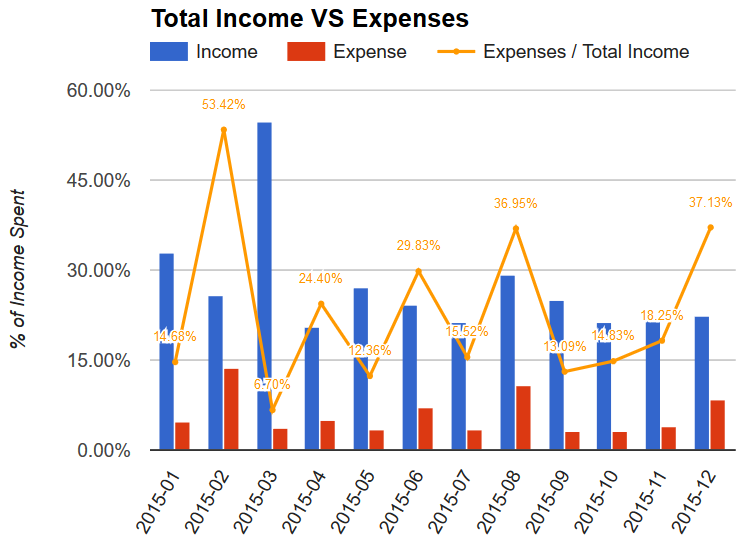
Expense were stable except for the month of August and November (you can see clearly the spike caused by our big angbao and new laptop).

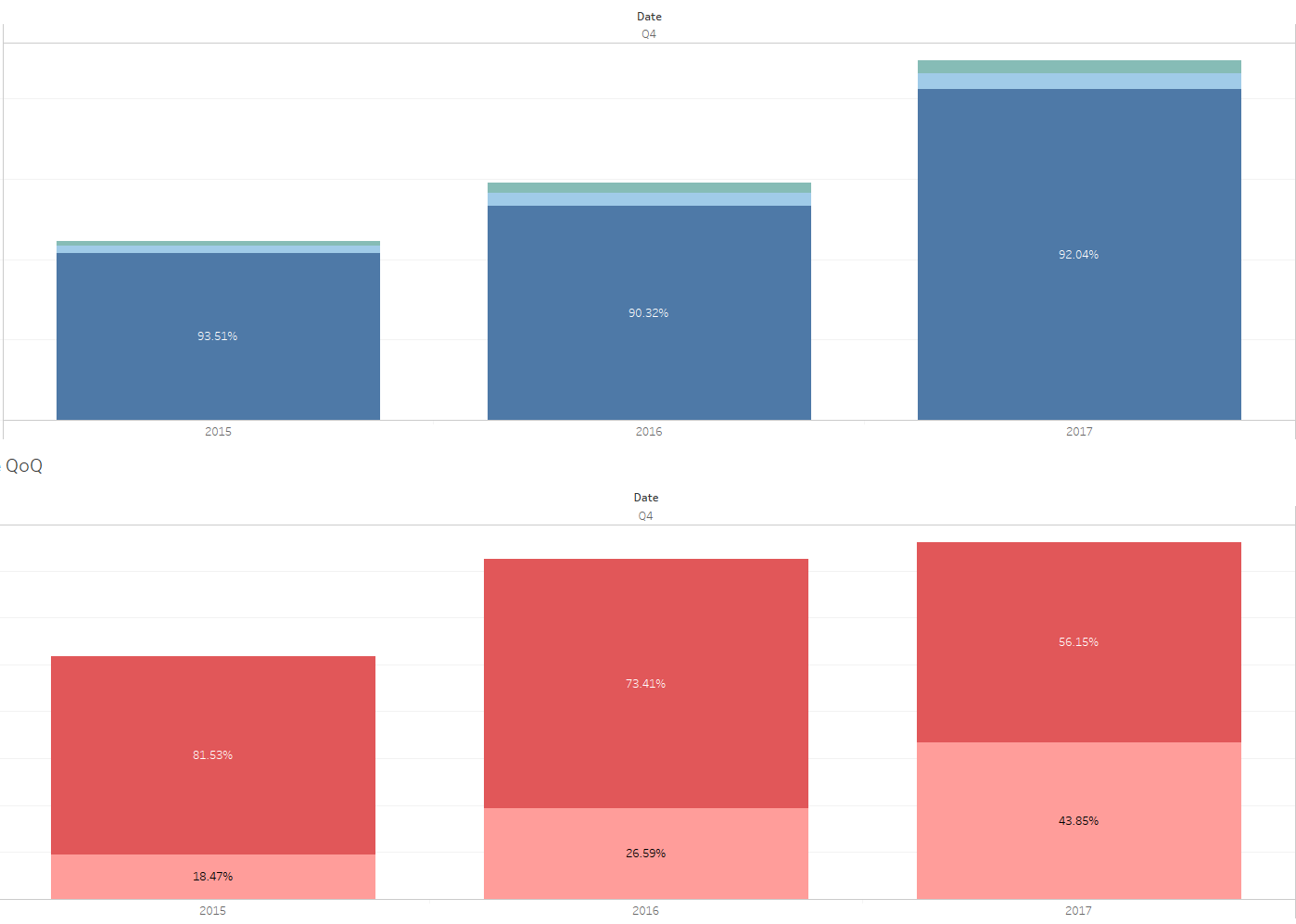
For the whole year, our expense as percentage of income stood at 19.5% (21.8% in 2016, 21.4% in 2015), translating to a crazy saving rate of 80.5%! This is skewed by a relatively low expense year, so it might be some time before we see such rate again.

As a percentage of our active income, we saved 89.5% of our salary!


-------------------------------------------------------------------------------------------------------------------------

Recurring Expenses Breakdown
After recording expenses for 3 years, many things are becoming more apparant as I now have a good base to see trends and make comparisons. This year would be considered "average" as I spend somewhere between 2015 and 2016.

I do see "one-time"expenses rising over time as I intend to give more to my parents every year. Recurring expenses should be stable at around 60 to 70% of total expenses.


Overall categorical expenditures are identical with last year - except that I spent much less on personal and entertainment this year. Top categories are the essentials - food, travel (transport) and utilities (internet and phone).

Random discovery time!

1. My lottery spending (Toto, 4D, Big Sweep) this year is $300, about $25 per month. I strucked Group 5 once and Group 6 a couple of times, earning back $80. There goes $200+ donation to Singapore Pools.

2. I ate fast food 68 times this year (counting lunch, dinner, supper)! I set a goal of 60 last year which I didn't meet, but it's still an improvement over 81 times last year.

3. I brought only 11 cups of Bubble Tea (i.e Koi, Gong Cha) this entire year, which costs me only $34 in total (Praised the $2 Liho promotions!). This was much better than 31 last year.

4. I brought 15 cups of Cafe drinks (i.e Starbucks, Coffee Bean) this year, totaling $63. Accounting the treats from others, it should be around 21 like last year.

5. I visited a restaurant only 20 times this year with each trip averaging $14.80. The low costs was largely due to subsidies like the NS50 vouchers.

6. I wenting singing in Singapore only 4 times this year (down from 8), each trip averaging $16.50. Anyone want go sing? :(

7. I spend approximately $1000 every year (average of past 3 years) on topping up EZ Link Card. That's around $90 per month.

8. I earned over $400 from MINDEF this year (10 ICT Sessions and IPPT-Pass)! I am strongly motivated not to go for IPT again, which unfortunately (fortunately) means $200 lesser next year.

-------------------------------------------------------------------------------------------------------------------------

Passive Income VS Recurring Expenses
This section strips out the "noise" and highlight only the recurring portion of expenses against passive income.

Year 2017, passive income is now sufficient to cover 82% of my recurring expenses (56% in 2016). Adding in the "double safety margin" criteria, it can cover 41% of my expenses. Once again, this is skewed by the low expense year.


-------------------------------------------------------------------------------------------------------------------------

Portfolio Performance
Glad to know that our time-weighted returns have beat the index every year except in 2014 when we first dipped into investing. I also think we achieved this on comparable volatility to the STI.

YearPortfolioES3
2014-2.94%7.00%
2015-8.12%-10.64%
201611.92%2.73%
201722.00%21.11%
Overall21.76%18.95%
Monthly Volatility (*in 2014, we only had 2 stocks)
YearPortfolioES3
201415.79%2.68%
20153.65%3.41%
20163.60%4.03%
20171.77%2.46%
Overall7.49%3.24%
Based on model statistics, our portfolio have a beta of 0.63 (average correlation with STI), with "Value At Risk" of 7.5% and "Expected Shortfall" of 9.6%. This means that in 99% of the cases, we would not suffer more than 7.5% loss in a month. In the 1% case, we can expect to lose 9.6%.

In terms of acquisitions, we added CapitaMall Trust, Far East Hospitality Trust, Singtel as well as a small stake in Netlink Business Trust. A majority of our returns this year came from the recovery of multiple REITS, especially CCT which continue to run despite the rights issue. The major loss came from the privataization of Super Group, which locked in 25% (about $1800) loss.

Our major holdings currently are Singtel (23%), the Capitaland REITs and the Frasers Family. Excluding the STI, we have a healthy and diversified portfolio of 10 holdings (up from 8 last year).

Compared with last year, we have grown the size of our portfolio by a staggering 72%!


-------------------------------------------------------------------------------------------------------------------------


Review of 2017 Goals
We fell short of the $5000 dividends/STI goal due to the bull market, and stop pursuing the Robo-investment strategy in consideration of the high management fees.

Outlook For 2018 
2018 strategy remain pretty much the same as before - continue to build a strong and diversified income portfolio. This time round, the markets are much higher than before and we have to be extra caution in case the black swan arrives.

Our ammunition have replenished entirely after December, and we intend to deploy them before the dividends season come in Q2. The major goal next year would be $6000 worth of dividends ($500/month!) - it's tough and we really need to see some great singapore sales to achieve this. SGXCafe projection currently is around $5300.

Next year main revenue would depend largely on whether our contract gets renew in Q4. If so, income should be slightly higher.

Given that we have replaced our phone in 2016 and brought a new laptop in 2017, we do not forsee any major expenses. There is a slight possibility (5%) of wanting to upgrade our PC if it completely breaks. There are plans currently to travel to nearby region in Q1, but it is not anything too lavish.

All in all, I expect next year expenses to be around +10% (mostly from increased angbao for parents) compare to this year. Let's see.

Long Term Goals
With 3 years of cashflow records, we can finally map a high level financial roadmap for the next 10 years. These are very rough estimates (guidelines), but I think they are something to look forward to:

By 2020, passive income should be able to pretty much cover all recurring expenses. By ~2022, we should be able to save 100% of our salary every month.

In Year 2022, we would also become eligible to buy a HDB flat - it will be a huge decision that we have to make when the time comes.

Before 2025, we should reach our "safety passive income" goal of covering our recurring expenses twice over.

All these are assuming that current circumstances remain unchanged (not losing our job, not getting married, no unexpected emergencies, catastrophic economic crisis, etc).


Monday, January 01, 2018

Letter To Shareholders (9) - Performance Review 2017Q4

Performance Highlights
The stock market continue its relentless ascend - The DOW is at all time high and cryptocurrency is all the craze nowadays. You know we are in a bubble when even uncles and students are trading cryptos. Humans never learn, do they?

“Bitcoin has no underlying rate of return,” said Bogle, 88, who started the first index fund in 1976. “You know bonds have an interest coupon, stocks have earnings and dividends, gold has nothing. There is nothing to support bitcoin except the hope that you will sell it to someone for more than you paid for it.” - Jack Bogle

Our portfolio underperformed this time, growing only 4.2% compared to 5.7% of the index. This is largely due to the lack of banks in our holdings. (greatly regret not buying OCBC/DBS last year). Nevertheless, we were able to ride on the growth of our REITs.

In the final quarter, we paid out about $600 in dividends (base on pay-date, hence excluding the massive injection from Singtel). We also became friends of SGXCafe in order to more accurately track our performance - look out for more statistics in our annual report!


Operating Highlights - Income
Overall income for the quarter was more than 50% higher compare to same period last year, making up for the 40% drop in Q1. Salary-wise, 2017Q4 was roughly equal to 2016Q1 due to shift in bonus period.

Aside from the bonus, income this quarter was pushed up by many factors:
- Passing with incentive for IPPT
- Birthday red packets from family
- Side "job" allowance
- Passive income a record for Q4.

Operating Highlights - Expenses
Our big purchase this quarter was a Lenovo laptop, which we brought after much consideration. This is our first laptop purchase after nearly 10 years (last brought in 2008 for University). It has better specs (8th Gen i5) compared to the Microsoft Surface and come in at a much lower price (with Pen, Keyboard all inclusive). Overall, we think it is a good value deal that would make our life at work easier.

Otherwise, regular expense is 20% lesser than last year. We did not spend much except for a couple of clothing/shoes brought mostly during 11-11 sales.


Acquisitions
We subscribed to CCT rights and add on to Singtel again on its continued weakness. Interestingly, we also brought Singtel during the same period last year.

We continue to believe that Singtel is currently at an attractive price and would buy more if we were not already heavily vested in it. Largest company in Singapore, 20 years dividend track record, mere 60+% payout ratio and a stable 4.8% yield.

Topping Up CPF
We seriously evaluated the possiblity of topping up our CPF to reduce tax - more specifically medisave. This is something we have been contemplating since 2014. The critical factor once again came down to our long term goal - do we want to retire after 55? Or earlier?

If your decision is to retire after 55, there is no doubt that topping up CPF is extremely attractive. In fact, we would advocate pumping as much as you can so that you can hit FRS by early 30s.

In the end, we still conclude that topping up contradict too much with our FIRE goal.

Outlook
More details to come in our Annual Report.

Saturday, November 18, 2017

Road To FIRE - Society Norms

There are many articles regarding the arduous and greatly misunderstood path of financial freedom. Often, it is not only about the struggles of saving and financial prudence, but a lot more comes from society pressure, norms and expectations.

Take a reader article from AK: Scolded by wife for thinking about financial freedom 

I can really feel the reader's struggles from his letter - it's something that is just not widely accepted in a society like Singapore.

It's similar to "expectations" to get married (despite it being a VERY BAD DECISION if you do it for the sake of doing so), expectations to "get a job", expectations to "climb the ladder". If you have no ambitions to chase these things, you're considered a "good for nothing" or "lazy bum".

I shall walk my own path - 不在乎世俗的眼光

“Creating a life that reflects your values and satisfies your soul is a rare achievement. In a culture that relentlessly promotes avarice and excess as the good life, a person happy doing his own work is usually considered an eccentric, if not a subversive. Ambition is only understood if it’s to rise to the top of some imaginary ladder of success. Someone who takes an undemanding job because it affords him the time to pursue other interests and activities is considered a flake. A person who abandons a career in order to stay home and raise children is considered not to be living up to his potential — as if a job title and salary are the sole measure of human worth.

You’ll be told in a hundred ways, some subtle and some not, to keep climbing, and never be satisfied with where you are, who you are, and what you’re doing. There are a million ways to sell yourself out, and I guarantee you’ll hear about them.

To invent your own life’s meaning is not easy, but it’s still allowed, and I think you’ll be happier for the trouble.”

--------------------------------------------------------------------------------------------------------------------------

On the positive side of thing, an interesting comment from the article by BigCatBlue:

"As an investor, I need people to believe in working and spending. Do it as much as possible. In put it crudely, greed is good. 

Imagine if the companies that I have invested in found out that most people, if not all people are financially secured. They don't need to slave over a mortgage, put good food on the table, upgrade their car and condo, and enjoy all the trappings life can offer. Employees will revolt! Who then will work for me while I collect dividend and enjoy a slower pace in life? 

Masses of people thinking of financial independence -- that I am afraid. Please labour on for our sake."

Thursday, November 16, 2017

Quarterly Results Review - 2017Q3

M1
Results continue to dip, but IMO it is actually not bad. There are signs of it bottoming (for now), with net profit declining 5% year on year. For 9 months it is down 13.5% (9M EPS from 12.6c to 10.9c), which seems to be in line with the stock price ($2 to $1.8). Service revenue increase 5% and mobile ARPU remain stable at $55. Mobile customers base fall due to shutdown of 2G network, and overall their market share is still stable at 25%.

They launched lots of initiatives this past quarter like malware detection solutions, nationwide IOT, smart sensors etc which would all take time to materialize. Yield at $1.8 is 6.1%, based on trailing results. The million dollar question is if they can sustain the current DPU.

Afternote: More news of first "intelligent" waste management system, cloud offering of digital startups. I might consider averaging down if I sell other position.


CapitaCommercial Trust
DPU still went up 2.6% despite selling away 3 buildings. This is the definition of a well managed REIT. Subscribed for their rights. Main catalyst now is Golden Shoe redevelopment and how they can bring Asia Square Tower 2 forward.

Afternote: For some unknown reason, CCT had a crazy run-up after the rights issue to over $1.8. The pro-forma NAV is $1.76 and 1H2017 DPU is 4.23 cents (annualized 8.46 cents). Considering a 9c DPU yearly, the yield is barely ~5%. This makes me really tempted to just sell it.

I believe it would be more fairly valued at $1.65 for a 5.5% yield.


CapitaMall Trust
A very flat quarter with regards to DPU, shopper traffic and tenants sales. Expect stable 11c DPU (5.4% yield at $2.04) until the launch of Funan in 2019.


Frasers Centrepoint Trust
Full-year DPU rose 1.2 per cent to 11.90 cents, the highest since the FCT's listing in 2006. Integration with Northpoint City North Wing is in its final stages.

My crown holding - low debt level (29%), 11 years of increasing DPU, NAV grown from 1.78 to 2.02 since I first vested in 2014, best management, super resilient. Every single quarter the results is good. What more can you ask for?

Stock price has reached an all time high (>$2.20) that sometimes, I am tempted to sell it in hope of getting it back at a lower price.


Far East Hospitality Trust
DPU falls 8% to 1.03c but the stock keeps going up - probably in anticipation of recovery next year (revenue for hotel rooms went up). There is also the acquisition of Oasis Downdown mid next year which is expected to be slightly accretive.


Sembcorp Industries
Saw a 37.7% drop in net profit due to several one off items - non-cash impairment charges and 11m of doubtful debts write offs. Marine show small profits again after losses last year.

Overall I think the company is stabilizing (Operation Profit up 11% for 9 months) and management indicate strategic review will be completed soon. NAV is up from $3.58 to $3.86.


Singtel
Only 3c special dividends (from about 14c gain) from Netlink IPO, on top of standard 0.68c (60% payout) dividends. Excluding Netlink, earnings fell 4% mainly due to intense competition in India.

Still feel confident that it should trade between $3.6 to $4.

Afternote: Fair results, down trending price? Singtel is the number 1 stock in Singapore by market cap, and deserve to at least trade at a "fair value". I strongly believe $3.6 can hold and increased my position again seeing the continued drop. Look forward to my 9.8c dividends in January next year.


Frasers Centrepoint Limited
Dividends maintained at 8.6c per year (60% payout ratio) and delivered yet another solid quarter with revenue/profit increasing 17%. NAV is now at $2.46.

Like that they are diversifying their income to now over 50% outside Singapore, and concentrating on growing their recurring income. This is the best "ETF" I ever brought.


Accordia Golf Trust
Ah! The big surprise this quarter. DPU plunged over 30% due to "unusually large return of members' deposit" despite profits and revenue going up. Hopefully this is a one time event.

To add further uncertainty, golf utilization fell ~15% as they were closed for 10 days due to typhoon in October. It does not sound good for their next quarter in view of the harsh winter ahead.

Given that I am comfortably in the money, I will hold and see.


Netlink Trust
Nothing much to say - everything according to forecast results and on track to meet target DPU.


Watchlist
Comfort Delgro - $1.9 and below would be extremely tempting.

SGX - Closer to $7.

Raffles Medical Group - Closer to $1.

Starhill Global Reit - 6.5% yield at $0.75.

Mapletree Comm Trust - Below $1.5, camping at 6% yield. NAV is $1.37.

ST Engineering - Would likely bite at 5% yield (closer to $3)

Capitaland - Look closer to $3.3 or below.

Mapletree Greater China Trust - $1.1 or when it retract to more than 7% yield.


Sunday, November 05, 2017

My Financial Feed

Over the past year, I'm getting bombarded by more and more newsletters, articles, emails and services. There are so many overlapping stuff and it's a real pain in the neck dealing with all the good and bad sources.

Hence, I'm taking this chance to consolidate these sources and pick out the cream of the crop.


Portfolio Tracking
To track our portfolio performance, monitor price changes. The ease of use, accessibility ,and user interface is of almost importance.

1. Yahoo Finance - A much inferior choice, after they brought down Google Finance.
2. SGXCafe - Favourite for monitoring day to day changes (email) and comprehensive reports.

Eliminated: Google Finance (was the best, until they decide to terminate it), MoneyMSN, Stockflock


Generic Stock News
We all need constant source of ideas to feed our minds.

1. Feedly - My personal consolidated source of around 100 blogs. I go here for inspiration and ideas.
2. Motley Fool - Promote long term investing but articles tends to get repetitive.


Analyst Reports & Price Targets
Professional analyst reports. Take them with a pinch of salt, but good reference for information.

1. SG Share Investor - Detailed analyst report
2. i3Investor - Consolidated price targets of analysts


Stock Information
1. Dividends.sg - Best consolidated dividend hsitory


Forums & Social
1. SSI and MoneyMind
2. InvestingNote


Mobile Apps
1. Spiking - Tracks 'big names' buys and sells
2. SGXMobile - Notification of company announcements
3. SG Stock Alert - Notification of company announcements


Procedures Before Buying
1. Search Info at Dividends.sg (dividends history, recent announcements)
2. Analyze company (latest results)
3. Read analyst reports and any other news


Procedures After Buying
1. Update ZZ Portfolio Tracker
2. Update Yahoo Finance
3. Update SGXCafe
4. Add Notifications to SGXMobile, Vezted

Sunday, October 01, 2017

Letter To Shareholders (8) - Performance Review 2017Q3

Performance Highlights
STI inches up slightly in Q3 by 0.8% while the Dow Jones continue to break historical high despite tensions with North Korea. Our portfolio grew by 0.5% with most coming from dividends. No major acquisitions in Q3 except for a very small stake in Netlink Trust gotten from IPO. Our assessment is still that the SG Market is fairly valued now, although some blue chips are falling into bargain territory.

We paid out dividends of over $1500, the highest ever for a single quarter. This is almost doubled the same period last year.


Operating Highlights
The most important milestone is that we have officially secured our revenue source, extending our lease expiry by another year. It comes with a good positive renewal, affirming the board's strategic decision last year.

Income for the quarter was about 23% higher largely due to mid year bonus in July. Other one-time revenue came from the numerous IPT sessions in August. We expect income to be higher in Q4 as well from the year end bonus, which should make up for the loss in Q1 this year.

Overall, total income this year should be comparable to last year.


Expenses were about 5% lower, with the only major expense being our traditional parents gift in August. August expenses would almost always be the highest in the year. If we exclude that, our fixed expenses would probably be some of the lowest 3 month period.

We do not foresee any major expense coming up for the rest of year, except the slight possibility of getting a laptop for work purposes.


Acquisitions & Divestments
We came very close for a few purchases but it always seem to slip us by, and now our cash holdings are almost back to Q1 level. The only purchase this quarter is a very small stake in Netlink Trust.

CapitaComm Trust would be doing a rights issue soon and while we are slightly doubtful of the acquisition (non DPU accretive), analysts claim it will be beneficial in the long term. That said, we see no reason not to sign up for it. Closing date is 19th October.

The general intention would be to once again deploy more into investments in the next 3 months, especially since we anticipate more cash inflow.

This is a first world problem. We are still deciding if we should make do with a little less margin of safety and make more "fair value" purchases instead of waiting for huge bargains.


Outlook
We have a long list of potential acquisition targets and prices that would warrant us to "take a closer look".

Comfort Delgro - This transport giant has fallen >30% from its $3 peak. Management guided declining revenue in almost all segments, and it is plagued by competition from Grab. However, we must know that only 30% of revenue comes from Taxis. Buses and MRTs are still largely profitable, and there must come a point where valuation is cheap enough to worth it. $1.9 and below would be extremely tempting.

SGX - Closer to $7. Monopoly business with a stable and safe 28c DPU per year. The problem is how much yield is sufficient to reduce capital-loss risk? We think 4% is fair while not being over excessive.

Raffles Medical Group - Closer to $1. Despite crashing near 40%, it is not really that cheap based on historical valuation (its PE is around 23, right around the 5 year mean). More investors are cutting back expectations after management guided "3 years turnaround time" for China operations. We are lacking healthcare exposure and still largely believe in RMG growth story in the long term (5 to 10 years). However, we need a good margin of safety, especially when this is not a dividend stock (1+% yield).

Starhill Global Reit - DPU was about 10% lower last quarter due to large number of AEIs. DPU per year should range around 4.92c to 5c range, which gives around 6.5% yield at $0.75.

Mapletree Comm Trust - Below $1.5, camping at 6% yield. Vivo City is a shopping paradise (well-managed and diversified, especially with the upcoming AEI) and Mapletree Business Centre is just icing on the cake. NAV is $1.37, so the key is just to not pay too high a premium.

ST Engineering - Compared to Singtel which has a higher yield of 4.7% (at $3.68) and lower payout ratio, ST Engineering just doesn't seem as appealing at $3.4. Their dividends are safe but stagnant. I have been looking to join back this solid Ah Gong company for a long time. and would likely bite at 5% yield (closer to $3)

Saturday, September 23, 2017

Rights Issue Advance Strategy Guide

All Credits of this post to BullyTheBear.

I have no intention of using the advanced strategies covered, but post here solely for my reference.

---

Now that the basic is covered, let's talk about strategies. There are strategies for existing shareholders who already holding shares before the rights exercise is announced, and there are also strategies for people who want to take advantage of the rights to get into the company at a favourable time. These are the wannabe shareholders. I must say rights issue favour the latter rather than the former. That's just the way it is.

I further define two types of player: the casual and the advanced one. Casual ones are usually newbies, but need not be, and quickly wants to get over the rights issue as soon as they can. Advanced players want to hack the rights and get a more favourable price, meaning getting their average price below the theoretical ex rights price (TERP).

w: no of mothers shares before XR
x: no of rights shares successfully subscribed
y: price of mother shares before XR
z: subscription price of rights shares
TERP = [(w*y)+(x*z)] / (w + x)

As you can see, to get a lower average price, you need to get much more excess rights beyond the rights ratio. If the rights ratio is 166 shares for every 1000 shares held before XR, to get a lower price than TERP, you need to get more rights shares than 166.

Link for casual rights player: here
Link for advanced rights player: here

For existing casual shareholders:
a. Just wait for offer information statement (OIS) to come in. It'll inform you of the number of entitled rights shares you have.
b. Go atm and subscribe to the entitled rights
c. At the same time, apply for the excess rights. There's also a $2 admin fee charged by every bank.

For existing advanced shareholders:
1. Sell all your mother shares before XR, buy back after XR and after the price drops lower than TERP
2. Buy more mother shares before XR and take adv of the drop in price, be entitled to more rights, apply for excess
3. Buy nil paid rights during nil paid rights trading period, esp when there are opportunities for arbitrage, subscribe to entitled and also apply for excess
* 2 and 3 can be combined, but make sure you know what you're doing

For casual wannabe shareholders:
a. Buy the mother shares before XR
b. Wait for OIS to inform you how much entitled rights you have. If you bought too close but still before XR, the OIS might not reach you on time. So calculate manually.
c. Go atm and subscribe to the entitled rights
d. At the same time, apply for the excess rights

For advanced wannabe shareholders:
1. Buy in after XR, at or below TERP, and skip all the rights exercise
2. Buy in before XR, get your entitled rights, apply for excess by maximizing rounding

Since preference is given for excess rights applicants to round off odd lots, and assuming that the rounding of odd lots is for 100 shares per board lot, it make sense to change the number of shares you want to buy before XR to maximise the odd lots rounding. For example, if you get 1000 shares before XR, you are entitled to get 166 excess. To round off to the next nearest round lots, you are almost guaranteed to get 34 excess rights (to round to 200 shares). Can we maximise that rounding so that you can get the best out of it?

In the past, where the board lot is 1000 shares, there's some savings to be had, but not anymore.
Just ignore this method safely, knowing that you are not going to hack a lot to get a lower average price using this method.

3. Buy nil paid rights during nil paid rights trading period, subscribe to entitled
* 2 and 3 can be combined, but make sure you know what you're doing

Rights Issue Step By Step Guide

I am experiencing my first Rights Issue with Capital Commercial Trust soon, and have scouted around the financial blogsophere for information on how to do this properly.

This post is not meant to address the specifics of CCT rights issue, but more a general guide on how rights work and how to apply for it.

Credits mainly to BullyTheBear, with bits and pieces of information from other sources.

----

1. Rights Issue Announcement

With rights issue announcement, the most important is the "X rights per Y shares at Z price" information. Upon the subscription of rights, the nil paid rights (named because you have not subscribed to it; you are just holding the rights) will convert to ordinary shares / paid rights.

4 Choices when right issue happen:
1. Sell your shares before the "ex-rights" date. (Before this date, all shares will include the value of the rights)
2. Subscribe. Otherwise, you risk facing dilution.
3. Sell Your Nil-Paid Rights (or buy more) during rights trading period. (Usually complicated and not worth the effort. Pay commission + short trading period)
4. Do nothing. (Worst option. Wasting money.)

If you want to subscribe, you have until the "Close of Rights Issue" date to press at the ATM.

---

2. Rights Trading

With "renounceable" rights, you can sell them off. For "non-renounceable" (also known as preferential offering), you can't. What price to pay for the rights?

This is for if you really want to do trading for the rights,

Nil paid rights price + Subscription price = Price of mother shares after XR

"The subscription price for this cct rights exercise is 1.363. Let's say upon XR, the price of cct mother share is at 1.450. The nil paid rights price should be trading at 0.087 (1.45 - 1.363). If the price of the nil paid rights is way below 0.087, then the logical question to ask if this: is the mother share overvalued or the nil paid rights undervalued? It presents an arbitrage opportunity here. But this is advanced technique to play with rights, and it's highly advisable for newbies not to do it unless you know what you're getting into."

*These rights would actually appear on your CDP account.

---

3. Entitled Rights

You can find this by calculating from how many shares you have.

If you don't want to calculate manually, or want to confirm, wait for the Offer information statement (OIS) to be sent to you. In it, there'll be a circular on the whys of the rights exercise, and the how to the different scenario where a shareholder can subscribe to the rights. Most important, there will be a form where they will tell you explicitly how much rights you are entitled to. You can either fill the form, send a cheque and post it to them for rights subscription, or just ignore the form and go to the atm to subscribe for the rights.

Take note of the "Last date and time for acceptance" in the document. You MUST subscribe or they will expire worthless by this date.

You will get fractional allotments of rights, but rounded down. For example, if the right issue is 50 for every 1000 shares, you will still be allocated 25 rights if you have 500 shares.

---

4. Excess Rights

You can also subscribe to excess rights above and beyond your entitled rights.

For example, if you are entitled to 830 rights, you will definitely be able to get 830 new shares, because well, that's your entitlement. But for the excess rights, preference will be given to round off odd lots and the rest is luck.

So, if you apply for 70 excess, you will likely get it (to round off to the 100/share lot size).

How much to apply the maximize?

Suggestion is to just put 1.0 your holdings before XR. It's unlikely you will get excess rights beyond the number of shares you hold originally, especially for a good company rights issue.

Let's say you have 5000 shares and are entitled to 830 shares. You can just apply 5000 - 830 = 4170 excess rights. In total you are applying for 5000 rights (830 entitled and 4170 excess) and you would have to pay for it. The rest will be refunded to your account.

Link to step by step guide on using ocbc atm to subscribe for rights: here

---

5. Check Allocated Rights

Date is listed as expected date of crediting rights units, usually 1 day before commencement of trading for rights share. You can check the CDP account around night time to ensure that the rights shares are credited. If that's slow, try checking the refund in the bank account where you applied for the rights. From the amount of money refunded to you, you can back calculate to see how much excess rights you got. The slowest confirmation is after a few days, you will get a snail mail of the rights shares you get through your physical mail box.

---

6. Pro Forma Figures
The Pro Forma Figures is a set of important figures that are usually presented in the circulars about the rights issue. The pro forma figures are estimated values of important financial figures such as yield, gearing, NAV, revenue, net profit, etc, assuming the rights issue has been carried out at an earlier date, usually 1 year or 6 months ago.

The past financial figures will be adjusted accordingly to factor in the effect of the rights issue. It will factor in the reduction in interest payment for debts if the funds raised has been used to pay up loans. If the rights issue comes together with proposed acquisitions of new properties, then the increase in distributable income from these new properties will be factored in. Most importantly, the increase in total outstanding shares will be factored in when calculating the figures such as yield and NAV.

The pro forma figures is an important set of figures to look at if you want to estimate the diluting effect of the rights issue. The yield may decrease in the short term due to the increase in the share base, but the pro forma figures will give an idea of yield in the middle to long term after factoring in payment of debts and income from new acquisitions. However, do take note that these are estimated figures, and the actual figures may turn out better or worse.